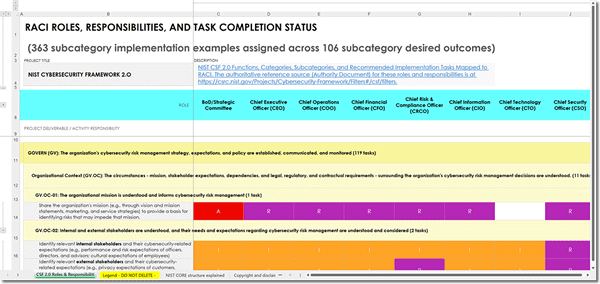
NIST cybersecurity framework nist csf 2.0

|
cybersecurity training |
online nist csf 2.0 program |
online cybersecurity exam course |
|
NIST training online course |
NIST certification online course |
online information security training course |
online NIST Framework training course |
online cisa certification course |
online certification course |
national institute of standards and technology critical infrastructure news events risk framework federal government
Lead Implementer Certification
Advance your career! Get trained and certified as an expert
in developing, implementing, and managing cybersecurity
according to the NIST Cybersecurity Framework 2.0 (CSF).
NIST CSF 2.0
Lead Implementer
Advance your career!
Get trained and certified
as an expert
in managing cybersecurity
according to
NIST Cybersecurity
Framework 2.0 (CSF).
Become a Certified NIST CSF 2.0 Lead Implementer
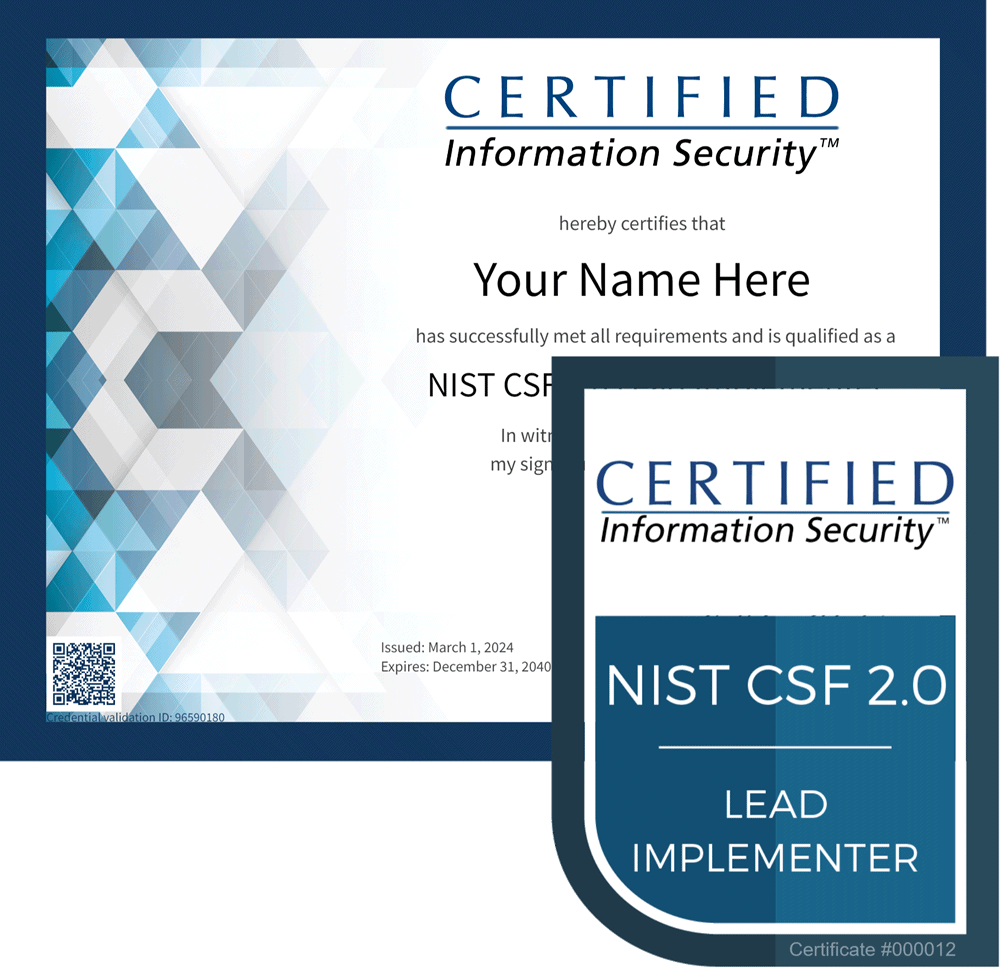 The Certified CSF 2.0 LI certification certifies your ability to implement the formal structure, governance, and policy of a robust cybersecurity framework following internationally recognized and respected NIST best practices and standards. Get trained and certified as an expert in developing, implementing, and managing a robust cybersecurity program according to internationally adopted NIST CSF governance and management best practices.
 Register for a class (in-person or virtual) and get started today!
NIST CSF 2.0 provides a policy framework of computer security guidance for how public and private sector organizations in the United States and around the world can assess and improve their ability to prevent, detect, and respond to cyber attacks. It is now the go-to playbook for countless organizations for building a robust data protection strategy.
Get trained and certified in implementing and managing NIST CSF 2.0

It’s convenient!
Certified Information Security provides the training and credentialing you need to become recognized as an authority in establishing and managing a world-class cybersecurity capability leveraging the Cybersecurity Framework 2.0. You choose the method of delivery: online through our secure website, or in-person at a publicly available course or privately at your facility. We take care of the rest – from administration, to record keeping, to providing certificates of completion and certification. Try it now for free!
Online students have the additional convenience of taking courses whenever they want without the need to travel or disrupt their busy schedules. Our program allows users to start and stop without losing their place or data. Learning and certifying expertise has never been so easy!
How to get started - two alternatives
 If your employer is paying for your training and certification, we recommend purchasing a complete NIST CSF 2.0 Lead Implementer certification package voucher that includes all required resources, including membership in the CIS Body of Certified Professionals, all required training programs, all recommended practice exams, and the required certification exam. This allows your employer to purchase and pay all of your necessary resources at once, while still giving you flexibility of when to use your training, practice exams, and certification exams later.


- "Pay-as-you-go" by purchasing your membership in the CIS Body of Certified Professionals, training, recommended practice exams, and the certification exams as you need them. Start by purchasing training, and then purchase practice exams when you are ready. After you complete your practice exams, you then purchase your certification exam.
A breakdown of the costs are as follows:
1. Required CIS Membership Application Fee & Membership Dues: $100.00 Learn more
2. Required Training
One Required Course | Online On-Demand Self-Study |
Certified NIST CSF 2.0 Lead Implementer |
$399.95
|
3. Optional Online Practice Exams for exam #CSF101: $75.00 Learn more
4. Required Online Certification Exam #CSF101: $100.00 Learn more
Certification Track and Process
Certified NIST CSF 2.0 Lead Implementer™
The Certified CSF 2.0 LI certification certifies your ability to implement the formal structure, governance, and policy of a robust cybersecurity framework following internationally recognized and respected NIST best practices and standards.
Upon completion of this training and certificate program, you will:
- be equipped with knowledge and skills required to manage, monitor, and improve policy and program in line with the CSF 2.0 and related standards of best practice;
- expand your cybersecurity competency;
- be prepared to integrate a robust cybersecurity program into an ISO 27001 Information Security Management System (ISMS)
- increase your credibility through gaining international recognition; and
- improve your résumé and help to increase your earning potential.

Getting certified is easy, and can be accomplished completely online. The NIST CSF LI 2.0 certification is available to qualified candidates who complete all of the following requirements:
- Are a member of CIS in good standing. If you are not already an Associate member of the CIS certification student body, you must first become a member to pursue the NIST CSF 2.0 LI credential.
- Attend the required approved curriculum courses, live or online. Prerequisite training: CIS' CSF 2.0 Lead Implementer training.
- Pass the Certified NIST CSF Lead Implementer Exam. For Lead Implementer certification, candidates must pass exam #CSF101. The exam is administered online and can be taken at your convenience at your home or work through the CIS eLearning Center, where your progress and score are monitored and recorded centrally. Your exam results are provided automatically upon completion of your exam.
- Complete and submit your CSF 2.0 LI certification application to the Certification Department at certification@certifiedinfosec.com. Certification applications are available for download at www.certifiedinfosec.com/services/certification-programs/cis-professional-certification-program/certification-kit-brochures-and-applications.
Your digital credentials
You will officially become certified (certificated) once your exam results and required documentation are validated and approved by the certification committee.
Your digital credential certificates and badges will be processed and emailed to you within 10 business days following the receipt of the required documentation. Learn more about CIS' digital certificates and badges.
Certification maintenance and renewal requirements can be viewed at www.certifiedinfosec.com/services/certification-programs.
Upgrade Paths: Certified ISO 27001 Internal Controls Architect, Certified ISO 27001 Internal Controls Architect, and Certified ISO 27001 Lead Auditor™
Certified Information Security is authorized to provide all required training and exams for Certified NIST CSF 2.0 Lead Implementer certification. NIST CSF 2.0 Lead Implementer certification candidates must successfully complete:
Exam delivery and proctoring
- Delivery: The exam is delivered online and on-demand on the CIS learning management system. Register for the exam now
- Do not purchase and exam until you are ready to take it since the exam must be started and completed within 48 hours of purchase.
- Proctoring: The exam is "open-book" and self-proctored.
- Questions: The certification exam has 65 questions randomly selected from a comprehensive pool.
- Time limit: The exam is timed, and must be completed within 70 minutes once started.
- Exam scoring:
- The exam is scored immediately upon completion.
- Passing score: 75%
Required Exam CSF101
Exam #CSF101 maps to NIST CSF 2.0 and related standards content areas taught in "Certified NIST CSF Lead Implementer 2.0"
- Required for CSF 2.0 Lead Implementer certification
CSF101 Content Areas
- Framework Core Functions
- Govern
- Identify
- Protect
- Detect
- Respond
- Recover
- Framework Implementation Tiers (Cybersecurity Risk Management)
- Risk Communication and Integration
- Framework Profiles
- Converging the CSF Framework into an ISO 27001 Information Security Management System
Qualified experience
Certified NIST CSF 2.0 LI is an entry-level certification. No previous experience is required.
Preparing for Certified Information Security's professional certification exam #CSF101 is serious business.
This is where we can help. If you first successfully complete:
- All prerequisite CSF 2.0 Lead Implementer certification training; and
- All CSF101 online practice exams
Certified Information Security guarantees your success in passing certification exam #CSF101.
If you do not pass exam #CSF101 on your first attempt after completion of your required course and practice exams, Certified Information Security will allow you to re-test at no additional charge until you successfully pass your certification exam.
1. What is Cybersecurity Framework 2.0 by NIST? Why do we need it?
The Cybersecurity Framework 2.0 is the latest version of the U.S. National Institute of Standards and Technology's (NIST) Cybersecurity Framework. Released in February 2024, CSF 2.0 provides a universal, risk-based guide for any organization to manage cybersecurity risks. It includes a new "Govern" function in addition to five other core functions - Identify, Protect, Detect, Respond, and Recover - to guide organizations in prioritizing and communicating cybersecurity efforts. The framework offers flexible guidance and resources to help organizations improve their resilience against cybersecurity threats, regardless of their size, sector, or maturity.
How do organizations benefit from NIST's CSF?
- Manage Cybersecurity Risks: It provides a high-level taxonomy of outcomes for understanding, assessing, prioritizing, and communicating cybersecurity risks.
- Improve Communication: The framework facilitates internal communication across all levels of an organization and improves communication with suppliers and partners.
- Integrate Risk Management: CSF 2.0 helps integrate cybersecurity risk management with broader enterprise risk management strategies.
- Enhance Cybersecurity Programs: It offers a voluntary, adaptable framework for implementing, maintaining, and improving cybersecurity programs.
- Strengthen Supply Chain Security: The updated framework places a greater emphasis on supply chain security and governance.
2. Who should use NIST's CSF 2.0?
Who needs NIST CSF 2.0?
All Organizations benefit from implementing sound cybersecurity. CSF 2.0 is designed for any organization that wants to improve its cybersecurity posture, including those in critical infrastructure, healthcare, finance, government, academia, and the broader private sector.
- Small and Medium-Sized Businesses (SMBs): The framework's adaptability makes it useful for smaller organizations to align cybersecurity with business goals, build trust, and stay compliant with standards.
- Government Agencies: Federal agencies are required to use it, and the framework helps them align with government-wide priorities and demonstrate commitment to security.
- Enterprises of All Sizes: Whether you are a large enterprise or a nascent tech company, CSF 2.0 provides guidance for managing and mitigating cybersecurity risks effectively.
Why do organizations need it?
- Risk-Based Approach: It helps organizations understand, assess, and prioritize their cybersecurity efforts to improve their overall security posture.
- Flexibility: The framework is non-prescriptive and can be tailored to fit an organization's specific business objectives, resources, and risk tolerance.
- Holistic Cybersecurity: CSF 2.0 emphasizes integrating cybersecurity into enterprise risk management and business operations, rather than treating it as a separate IT function.
- Supply Chain Focus: The updated framework includes enhanced guidance on managing supply chain risks, a crucial aspect for organizations of all types.
- Emerging Technology Guidance: It offers insights for securing newer technologies like artificial intelligence, IoT, and cloud computing.
3. Is NIST's CSF 2.0 mandatory for regulatory compliance?
No, the Cybersecurity Framework 2.0 (CSF 2.0) is not mandatory for most organizations since it is a voluntary framework offering best practices for cybersecurity risk management.
However, compliance is mandatory for U.S. federal agencies and their supply chain partners, and it may be referenced in contracts or specific industry regulations. Many organizations adopt it voluntarily to enhance their cybersecurity posture and align with industry standards.
Who needs to comply?
- U.S. Federal Agencies: Compliance is mandatory for U.S. federal government agencies, according to Executive Order 13800.
- U.S. Federal Supply Chain Partners: Organizations that contract with federal agencies or handle government data are also required to align with the framework.
- Other Commercial Sector Supply Chain Partners: Private businesses and organizations in any sector often adopt the framework to complyu with customer-related contract requirements.
4. What types of cybersecurity risks does CSF 2.0 address?
CSF 2.0 addresses the full spectrum of cybersecurity risks organizations face, including supply chain, emerging technologies, privacy, and financial risks, by providing a framework to manage cyber risks in alignment with broader enterprise risk management (ERM) goals. The 2024 update expands guidance beyond critical infrastructure to all organizational sectors and integrates the new Govern function to centralize decision-making and strategic planning for managing risks across various domains.
5. How does an organization get started using CSF 2.0?
To get started, the organization needs to:
- Establish formal Cybersecurity Management Function leadership, authority, and subject-matter expertise. One of the most critical first steps is to establish clear accountability and governance by defining who is responsible for managing cyber risks. Organizations can create a cross-functional committee with representatives from legal, IT, compliance, and relevant business units. A team of cross-functional leaders (e.g., directors, vice presidents, officers, and managers) with sufficient organizational authority must be designated and trained to establish a formal cybersecurity governance and risk management Function/Department/Office. Optimally,the organization should even consider appointing a Chief Information Security Officer to lead the effort.
- Leadership authorizes, initiates, and plans the organization's cybersecurity management system to support the organization's greater enterprise governance, risk, and compliance management.
- The Cybersecurity Framework is used to improve cyber risk governance, assessment, and treatment practiced within the formal information security management system.
6. Can I get certified as a subject-matter expert in CSF 2.0 implementation and assessing/auditing?
Yes! Certified Information Security is the only IRMCB-accredited and authorized training provider and certification exam proctor for the NIST CSF 2.0 Lead Implementer and NIST CSF 2.0 Lead Auditor professional credentials.