NIST cybersecurity framework NIST CSF 2.0

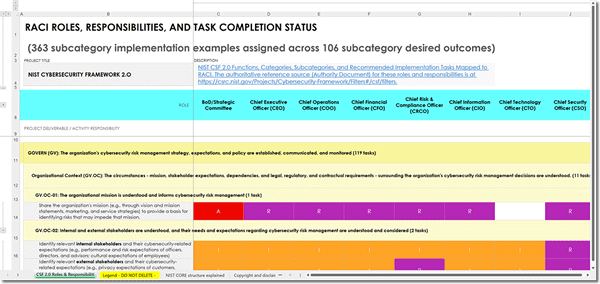
Image of NIST Cybersecurity Framework certification

cybersecurity training

online nist csf 2.0 program

online cybersecurity exam course

NIST training online course

NIST certification online course

online information security training course

online NIST Framework training course

online cisa certification course

online certification course

national institute of standards and technology critical infrastructure news events risk framework federal government

NIST Cybersecurity
Framework 2.0
Lead Auditor Certification

Get trained and certified as an expert
in auditing and assessing cybersecurity
according to NIST CSF 2.0.

Certified NIST CSF 2.0
Lead Auditor

 Advance your career.

Get trained and certified as an expert
in auditing and assessing cybersecurity
according to the
NIST Cybersecurity Framework 2.0 (CSF).

Get certified as an expert in assessing and auditing cybersecurity according to the NIST CSF 2.0

CSF 2.0 Lead AuditorAssessing the organization’s cybersecurity program against the key capabilities and objectives is the cornerstone of cybersecurity improvement and optimization. Internal and external stakeholders have a vested interest in managing cyber risk, and measuring the organization’s cybersecurity processes, procedures, and controls against desired cybersecurity objectives provides the basis for identifying critical risk exposures and opportunities for improvement. CSF 2.0 now provides 106 desired cybersecurity outcomes/objectives along with 363 implementation recommendations.

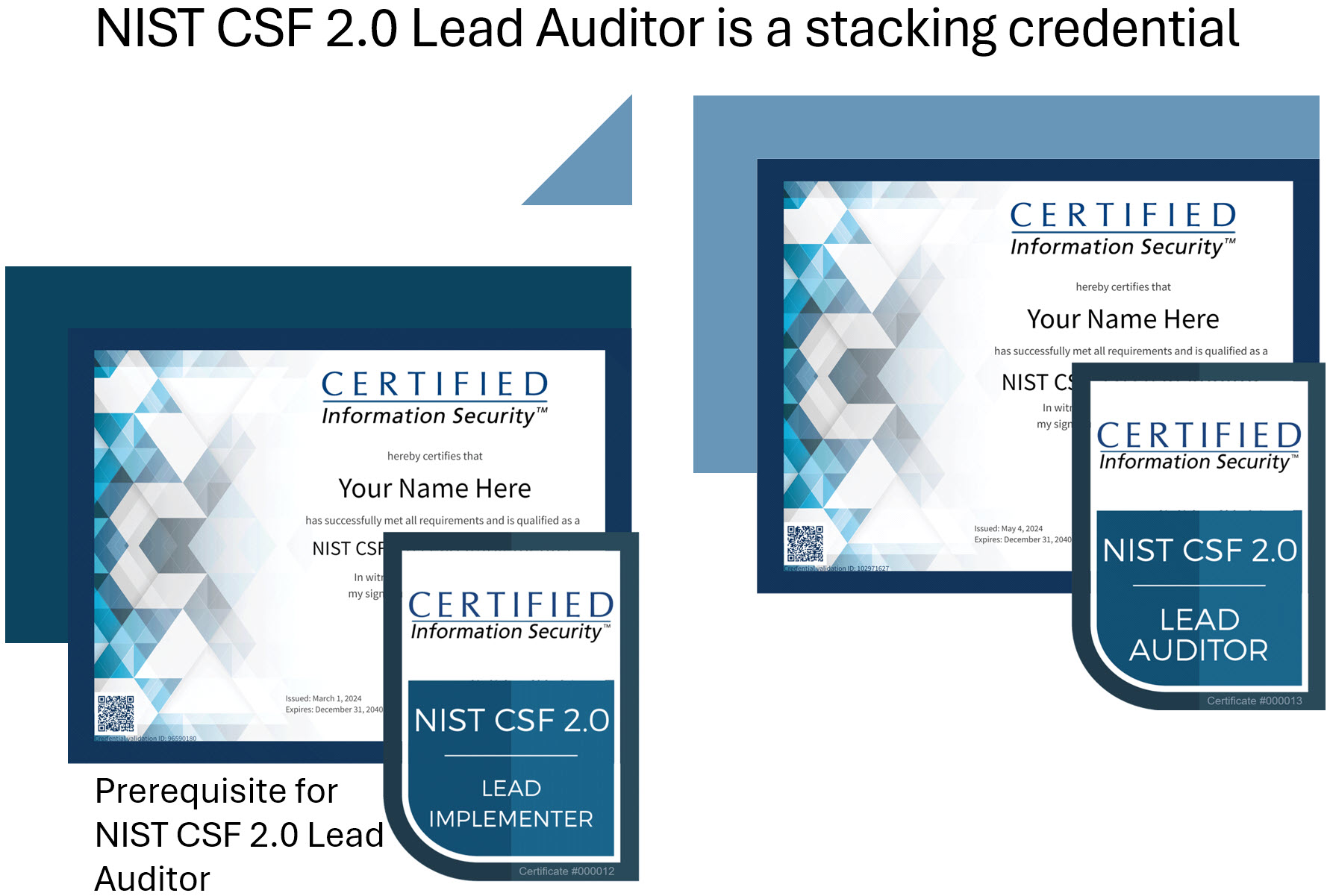
The Certified CSF 2.0 Lead Auditor credential certifies your ability to assess and audit the formal structure, governance, and policy of a robust cybersecurity framework following internationally recognized and respected NIST best practices and standards. The Lead Auditor program extends your CSF 2.0 Lead Implementer knowledge with an advanced understanding of how to assess, audit, and document the 106 goals and objectives of CSF 2.0 and its 363 corresponding recommended implementation tasks. 

Upon completion of this training and certificate program, you will:

  • be equipped with knowledge and skills required to audit a CSF policy and program in line with the CSF 2.0 and related standards of best practice;
  • expand your cybersecurity competency;
  • increase your credibility through gaining international recognition; and
  • improve your résumé and help to increase your earning potential.

Register for a class (in-person or virtual) and get started today!

The Cybersecurity Framework 2.0 provides a policy framework of computer security guidance for how public and private sector organizations in the United States and around the world can assess and improve their ability to prevent, detect, and respond to cyber attacks. The framework has been translated to many languages, and is used by the governments of Japan and Israel, among others. It is now the go-to playbook for countless organizations for building a robust data protection strategy. Get trained and certified as an expert if auditing NIST CSF 2.0 conformance. 

Is this NIST CSF 2.0 Lead Auditor certification only for auditors? How does it help people who implement and manage cybersecurity? What about people who participate in governing or practicing cybersecurity, but are not part of the specialty cybersecurity team?

This CSF 2.0 Lead Auditor training is NOT just for cybersecurity specialists and auditors! While the foundation level CSF 2.0 Lead Implementer training and certification makes you aware of the 363 tasks NIST recommends for CSF 2.0 implementation, this CSF 2.0 Auditor training takes a deep dive into performing each of these 363 implementation tasks. Accordingly, this program is invaluable to anyone playing a role in governing, managing, or practicing cybersecurity. CSF 2.0 governing, planning, implementation, operational practice, and improvement requires baseline assessments (audits) to determine gaps targeted for improvement. This means CSF 2.0 governors, planners, and implementers perform gap-assessments and audits as part of their normal everyday CSF 2.0 roles and responsibilities.
FAQ's

1. What is Cybersecurity Framework 2.0 by NIST? Why do we need it?

The Cybersecurity Framework 2.0 is the latest version of the U.S. National Institute of Standards and Technology's (NIST) Cybersecurity Framework.  Released in February 2024, CSF 2.0 provides a universal, risk-based guide for any organization to manage cybersecurity risks. It includes a new "Govern" function in addition to five other core functions - Identify, Protect, Detect, Respond, and Recover - to guide organizations in prioritizing and communicating cybersecurity efforts. The framework offers flexible guidance and resources to help organizations improve their resilience against cybersecurity threats, regardless of their size, sector, or maturity. 

How do organizations benefit from NIST's CSF?

  • Manage Cybersecurity Risks: It provides a high-level taxonomy of outcomes for understanding, assessing, prioritizing, and communicating cybersecurity risks. 
  • Improve Communication: The framework facilitates internal communication across all levels of an organization and improves communication with suppliers and partners. 
  • Integrate Risk Management: CSF 2.0 helps integrate cybersecurity risk management with broader enterprise risk management strategies. 
  • Enhance Cybersecurity Programs: It offers a voluntary, adaptable framework for implementing, maintaining, and improving cybersecurity programs. 
  • Strengthen Supply Chain Security: The updated framework places a greater emphasis on supply chain security and governance. 

2. Who should use NIST's CSF 2.0?

Who needs NIST CSF 2.0?

All Organizations benefit from implementing sound cybersecurity. CSF 2.0 is designed for any organization that wants to improve its cybersecurity posture, including those in critical infrastructure, healthcare, finance, government, academia, and the broader private sector. 

  • Small and Medium-Sized Businesses (SMBs): The framework's adaptability makes it useful for smaller organizations to align cybersecurity with business goals, build trust, and stay compliant with standards. 
  • Government Agencies: Federal agencies are required to use it, and the framework helps them align with government-wide priorities and demonstrate commitment to security. 
  • Enterprises of All Sizes: Whether you are a large enterprise or a nascent tech company, CSF 2.0 provides guidance for managing and mitigating cybersecurity risks effectively. 

Why do organizations need it?

  • Risk-Based Approach: It helps organizations understand, assess, and prioritize their cybersecurity efforts to improve their overall security posture. 
  • Flexibility: The framework is non-prescriptive and can be tailored to fit an organization's specific business objectives, resources, and risk tolerance. 
  • Holistic Cybersecurity: CSF 2.0 emphasizes integrating cybersecurity into enterprise risk management and business operations, rather than treating it as a separate IT function. 
  • Supply Chain Focus: The updated framework includes enhanced guidance on managing supply chain risks, a crucial aspect for organizations of all types. 
  • Emerging Technology Guidance: It offers insights for securing newer technologies like artificial intelligence, IoT, and cloud computing. 

3. Is NIST's CSF 2.0 mandatory for regulatory compliance?

No, the Cybersecurity Framework 2.0 (CSF 2.0) is not mandatory for most organizations since it is a voluntary framework offering best practices for cybersecurity risk management.

However, compliance is mandatory for U.S. federal agencies and their supply chain partners, and it may be referenced in contracts or specific industry regulations. Many organizations adopt it voluntarily to enhance their cybersecurity posture and align with industry standards.

Who needs to comply?

  • U.S. Federal Agencies: Compliance is mandatory for U.S. federal government agencies, according to Executive Order 13800. 
  • U.S. Federal Supply Chain Partners: Organizations that contract with federal agencies or handle government data are also required to align with the framework. 
  • Other Commercial Sector Supply Chain Partners: Private businesses and organizations in any sector often adopt the framework to complyu with customer-related contract requirements.

4. What types of cybersecurity risks does CSF 2.0 address?

CSF 2.0 addresses the full spectrum of cybersecurity risks organizations face, including supply chain, emerging technologies, privacy, and financial risks, by providing a framework to manage cyber risks in alignment with broader enterprise risk management (ERM) goals. The 2024 update expands guidance beyond critical infrastructure to all organizational sectors and integrates the new Govern function to centralize decision-making and strategic planning for managing risks across various domains. 

5. How does an organization get started using CSF 2.0?

To get started, the organization needs to:

  1. Establish formal Cybersecurity Management Function leadership, authority, and subject-matter expertise. One of the most critical first steps is to establish clear accountability and governance by defining who is responsible for managing cyber risks. Organizations can create a cross-functional committee with representatives from legal, IT, compliance, and relevant business units. A team of cross-functional leaders (e.g., directors, vice presidents, officers, and managers) with sufficient organizational authority must be designated and trained to establish a formal cybersecurity governance and risk management Function/Department/Office. Optimally,the organization should even consider appointing a Chief Information Security Officer to lead the effort.
  2. Leadership authorizes, initiates, and plans the organization's cybersecurity management system to support the organization's greater enterprise governance, risk, and compliance management.
  3. The Cybersecurity Framework is used to improve cyber risk governance, assessment, and treatment practiced within the formal information security management system.

6. Can I get certified as a subject-matter expert in CSF 2.0 implementation and assessing/auditing?

Yes! Certified Information Security is the only IRMCB-accredited and authorized training provider and certification exam proctor for the NIST CSF 2.0 Lead Implementer and NIST CSF 2.0 Lead Auditor professional credentials.

Learn more

0
Shares